
Inside the Marshall County Most Wanted Program
The Marshall County Sheriff's Office keeps a contact page, a tip line for criminal or drug activity, and a jail custody roster. What it does not publish is a most wanted list, a poster gallery, or any rewards program. The county website, its departments directory, and the sheriff's own navigation offer no fugitive page at all. That absence is simply how the office operates, not an invitation to fill the gap with names scraped from elsewhere. A site hosting a roster of private individuals would be a different product entirely. It would also carry serious accuracy problems, since third-party warrant data goes stale fast.
What Marshall County Does Not Publish
No names, photographs, mugshots, dates of birth, addresses, or charge lists appear here. That rule holds even when a private website offers such a list, because those sites are not official and their records go stale quickly. The sheriff's own custody roster carries an explicit accuracy disclaimer and a warning against relying on it for legal action. What the official Marshall County sources do provide is practical: how a real most wanted program works, where a tip actually goes, and how to verify a claim before acting on it. A reader who needs a status check gets a route rather than a lineup of strangers. Note: A custody roster shows people in jail at the time of an update, which is a different thing from a curated public-safety list.
How Marshall County Most Wanted Lists Work
Where a sheriff or a Crime Stoppers partner runs a most wanted program, the list is a curated outreach product, not a complete record set. The agency picks cases that meet its criteria, posts a handful of them, and updates the page as people are located. It is never the full set of open warrants, and it is never a warrant records check. Marshall County publishes no such list. There is no update schedule to describe and no selection criteria to quote. Anyone who finds a third-party page claiming otherwise should treat it as unverified until an official Marshall County or state source confirms it.
Fake Warrant Calls in Marshall County
Scammers work this angle hard. The Minnesota Judicial Branch warned in August 2025 that callers pose as law-enforcement officers, claim a warrant exists, and push for personal information or immediate payment. The tell is the pressure. Courts do not collect money by demanding gift cards, wire transfers, or payment over the phone from someone just told a warrant exists. The Judicial Branch scam warning describes the calls and the correct response.
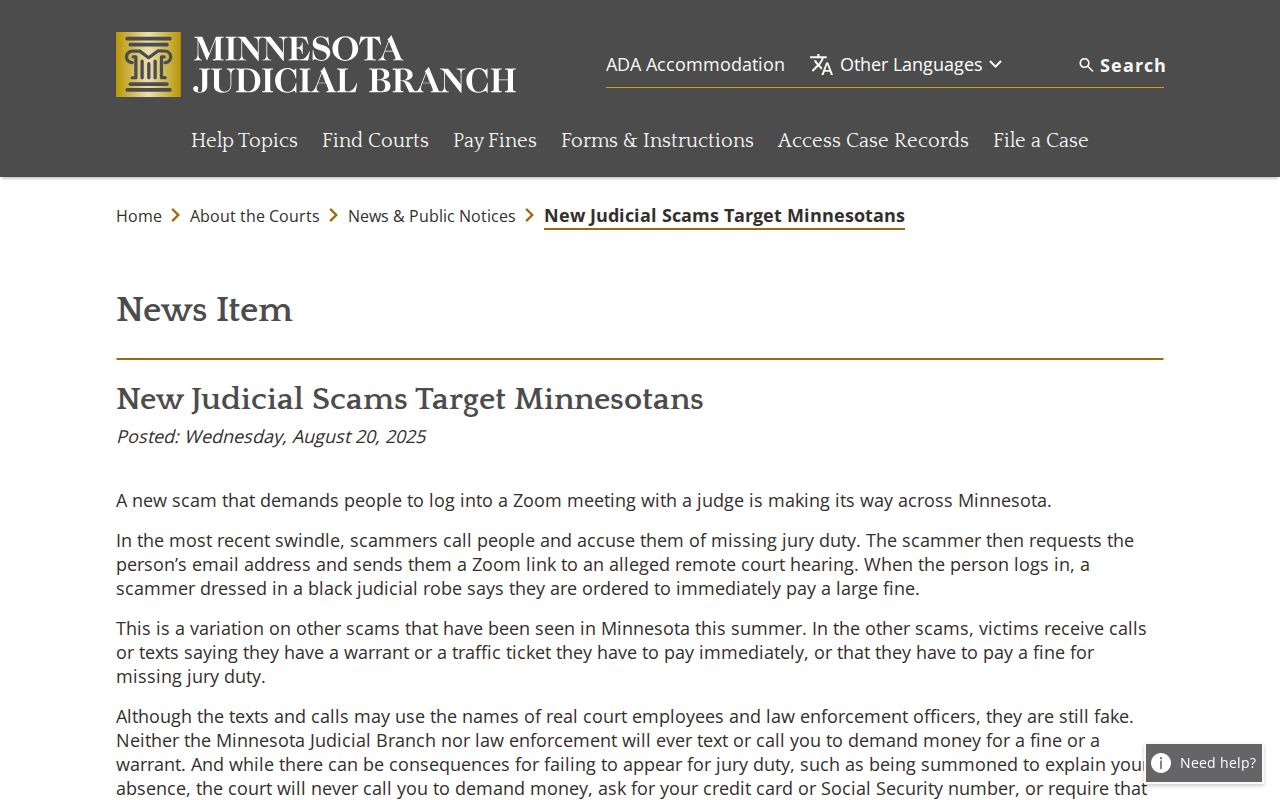
Verify any warrant claim yourself. Call Marshall County District Court at 218-745-4921 or the sheriff at 218-745-5411, using a number you looked up on your own.
Sending a Most Wanted Tip Safely
The sheriff's tip line exists for information about criminal or drug activity. It is not a warrant status line. It is not a records request channel either. If you know something about a crime in Marshall County, use the official contact and keep the message factual: what you saw, where, and when.
Key Point: A tip line and a warrant check are different services, so do not send a personal status question to the tip address.
Emergencies belong with 911. For a records question, use the Marshall County request form or call the office holding the file.
The Federal Fugitive Route From Marshall County
Federal fugitive matters run outside the county system. Marshall County sits inside the federal District of Minnesota, and the U.S. Marshals Service district page lists Marshall among the counties it serves. That page publishes headquarters contacts, a fugitive task force number, and courthouse locations. Its profiled fugitives section, though, shows no fugitive information for the district. An empty module only means no profile was posted. It does not prove that no federal warrant exists anywhere. The U.S. Marshals District of Minnesota page carries the district contacts and the counties served.
How Most Wanted Differs From an Active Warrant
People mix these terms up, and the offices involved do not. A most wanted list is a curated outreach product. An active warrant is an operational status inside a court file.
| Point | Most Wanted List | Active Warrant |
|---|---|---|
| Who decides | An agency or program selects the cases | A judge issues the process |
| How complete | A small, curated subset | One case in the court file |
| Update cycle | Set by the program | Changes when the court or agency acts |
| Where confirmed | The official program page | Court administration and the sheriff |
Public-Safety Tips and Records Requests
Two channels, two different needs. Mixing them slows both down. A public-safety tip goes to Marshall County law enforcement and may be time sensitive. A records request goes to the office keeping the file, and it asks for documents or data rather than action.
| Crime information | The sheriff's tip line or 911 in an emergency. |
|---|---|
| Warrant status | Marshall County District Court Administration at 218-745-4921. |
| Custody question | The sheriff's office at 218-745-5411. |
| Records or data request | The county citizen request form, with a department selected. |
When You Believe You Are Listed
Start with the court file, not a website. Call court administration, confirm whether a case exists, and ask what type of process is attached. Ask whether the warrant has been recalled or cleared too. If one is open and authorizes arrest, speak with an attorney before appearing anywhere in person in Marshall County.
Important: Do not confront anyone about a list, and do not pay a caller who claims a warrant exists without verifying the case yourself.
Verifying a Program Page Before You Trust It
Before you trust any Marshall County most wanted page, run a quick check. Does it sit on a county, city, or state domain? A named agency, a matching phone number, an update statement, and a way to report tips all point to the real thing. Pages that hide who runs them, lift text from elsewhere, or charge a fee fail every one of those tests.
- Check whether the domain belongs to the agency that claims the page.
- Match the phone number against the sheriff's own contact page.
- Look for an update date and an accuracy statement.
- Compare any roster against the county's own sites, which publish none.
- Report a suspicious page to the agency it imitates.